Showing posts with label Review by Adrian Morris (1st controller). Show all posts

Friday, June 19, 2009

"Rock Band Unplugged" Review: Let There Be Rock!


It’s weird playing “Rock Band” or “Guitar Hero” without their plastic counterparts. Even “Guitar Hero: On Tour” was bundled with a peripheral. So I admit to being skeptical of “Rock Band Unplugged,” but I remembered that my favorite rhythm games like “Frequency,” “Beatmania” and “DJ Max Fever” did not have peripherals. While the sudden transition to PSP seemed odd, the “Rock Band” experience has respectfully been preserved.

The goal of “Rock Band Unplugged” is to conquer the rock world one gig at a time. Band world tour mode is back, and it’s as streamlined as it was in “Rock Band 2.” This means players only have to repeat songs during the larger setlists in cities. Players can still customize their band’s outfits, hairstyles and guitars. Collecting every item is reasonable, and hiring different staff to tour with your band will help earn more money, fans or allow new venues to be accessed.

While each instrument is still on it’s own track, players can switch from bass, drums, vocals and guitar. Each instrument track is divided into phrases, and completing a phrase will make the rest of the track disappear until the next phrase is ready. Players will then have a second or less to switch to the next indicated track. This adds some challenge to the game, but most players will find it easy to adapt to. The biggest problem I had was accidentally switching past the track I needed to play.

Missing a phrase continues the current track and causes the crowd meter to drop, and because each track is meant to be completed the first time, another instruments’ phrase will begin. While this may seem overwhelming, it’s not as long as players stay focused or use overdrive to recover. Chaining notes and phrases will increase the score multiplier, and the band will enter a groove after the multiplier reaches 5x, and using overdrive will increase the multiplier to 11x. One minor complaint is that activating overdrive briefly slows the track’s frame rate enough to throw some players off rhythm.

Because “Unplugged” uses two directional pad buttons and two face buttons for each note, and the shoulder buttons to switch tracks, players who usually play on hard difficulty in “Rock Band” will probably like expert difficulty in “Unplugged.” I played on expert and it’s slightly more difficult than hard.

New modes like band survival, warm up and training are specific to “Unplugged.” Band survival allows players to play each instruments’ track without phrases and it’s the most difficult mode because players have to constantly manage the crowd meter. However, warm up mode serves the same function, but without penalizing players for not playing other tracks. It’s a great way to play one instrument throughout a song. Training mode is a great way for beginners who have never played any rhythm game to understand the fundamentals of “Rock Band Unplugged” or other similar rhythm games. Unfortunately, there is no practice mode, but it would have been a great way for players to learn difficult solos.

“Rock Band Unplugged” is on par with the presentation and production value of “Rock Band 2.” The transition between menus is seamless, and the personality displayed throughout the “Rock Band” franchise is still apparent. Graphically, “Unplugged” uses similar colors and effects from “Rock Band 2.” Harmonix and Backbone Entertainment did a great job keeping the look and feel consistent with the franchise, and while the stages look similar, the graphics will grab most peoples’ attentions and players can expect the graphics to look as well as other high production PSP titles.

The song selection is awesome. I enjoyed playing every song with the exception of some metal songs. “Unplugged” has some songs from previous rhythm games like “Carry On Wayward Son” by Kansas and “Everlong” by the Foo Fighters, but the addition of “Buddy Holly” by Weezer, “ABC” by the Jackson 5 and “Rock Your Socks” by Tenacious D help round out the great song selection. As a whole, the setlist has a consistent relaxing vibe and I really enjoyed the emphasis of each instrument during its phrase.

The music store is also included, and downloadable songs are already posted at $1.99 each. While it seems expensive for a song to play on the PSP, song packs and albums will help increase the replay value. “Rock Band Unplugged” would be a decent 4-player game, but the lack of multiplayer or an online leader board will be puzzling for players looking for competition after completing tour mode.

“Rock Band Unplugged” is a solid rhythm game. The songs are fun to play, the notes are synced perfectly and pulling off a perfect guitar or drum solo feels great. Extras like no fail mode, the ability to unlock all songs and playing without solos is an awesome addition that makes “Unplugged” the most accessible rhythm game I have played. “Rock Band Unplugged” is a great addition to the PSP’s small rhythm game library, and I dare say it could tear me away from my beloved “DJ Max Fever” obsession.

Rating: B+
Publisher: Electronic Arts
Dev: Backbone Studios and Harmonix
Price: $39.99
ESRB: T for Teen
Players: 1

Wednesday, June 10, 2009

"inFAMOUS" review: Shock or Be Shocked!


I originally was not too hyped for “Infamous,” and I was not a fan of the “Sly Cooper” series, but I trusted Sucker Punch, the developer, to create an interesting experience. I thought I would just play a solid game, but I found an experience that offered much more.

“Infamous”  begins 14 days after Cole, a mail courier, is found at the epicenter of an explosion that leaves Empire City quarantined by the U.S. government. The blast gives Cole electrical powers and it’s up to him to save the city from gangs that have taken advantage of the explosion, or to take over the city himself. Cole is also on a mission to escape Empire City, to uncover who gave him the package and to  protect his relationship with his girlfriend Trish and best friend Zeke. 

“Infamous” features a huge sandbox world with no loading.  It’s easy to compare “Infamous” to “Crackdown‘s” superhero gameplay fused with “Assassin’s Creed’s” parkour mechanics. Cole can climb everything from phone booths to sky scrappers with ease. The controls are simple, and pressing X makes Cole jump from object to object. Cole’s body acts similar to a magnet when he jumps from any object to another, but it felt natural and helped me become confident to jump further distances. The mechanics feel very similar to “Sly Cooper,” so the platforming and climbing felt organic and I enjoyed traversing the city.

Cole’s powers are integrated into the city’s power grid so absorbing electricity from nearby power transformers or cars will replenish Cole’s health and energy. Sucker Punch did an awesome job always keeping Cole within range of electricity, and Cole’s “spider sense” is shows nearby electrical sources on screen and on the radar. Some areas of Empire City have not had power restored and are dangerous to venture into early on. Cole gains another power every time he restores electricity to each section of the city.

Cole’s powers develop through karma choices and his rank. Choosing the evil path will make Cole’s powers focus on destruction, while Cole’s good powers allow him to target specific enemies to avoid harming nearby citizens. There are over eight powers in “Infamous” and each have three ranks of upgradeability along with being good or evil. I played through “Infamous” completely evil, and the result was insane. 

Karma choices effect Cole’s power development and rank . These moments allow you to decide whether Cole is good or evil. Honestly, the choices do not feel creative until the end of the game, but some earlier choices will effect the storyline. The game pauses and explains the situation and what choice will make you good or evil.

Healing citizens or making the right choice will increase Cole’s karma meter toward good and after an amount of time his rank will increase. The last ranks are infamous and hero. When a new rank is reached, Cole’s good or evil powers are available to upgrade. However, if Cole loses his rank by making too many opposite choices from his current karma, he will lose the ability to use the power level until he increases his rank again. 

People pushed Cole and gathered crowds to stone him when I became infamous. While it rewarded them with a shock or two, I had to become cautious of them while fighting against gang members. 

I constantly picked fights with gangs and citizens to arc electricity between them and finish someone with a head shot that would create an explosion that would arc to others. If enemies take cover behind cars, blow up every car around them and toss in electric grenades to make if flashy. “Infamous” successfully makes evil feel great, completing stunts keeps combat fresh while introducing creative ways to dispatch enemies. 


While the graphics in “Infamous” do not stand out, the story’s presentation and replay value do. The story is shown through digital graphic novel panels that are vibrant and captivating, and interesting broadcasts on television. Cole effectively narrates each panel and I was eager to watch the next one. The city is externalized through television broadcasts. One voice labels Cole a terrorist and negates his good deeds by saying it was other citizens, while the other is a news reporter who disguises Cole’s deeds as the government’s. The 350 blast shards scattered throughout the city are addicting to collect, and the scattered radio messages provide useful background information to the story. 

“Infamous’” only negative points are its graphics, the enemies being too accurate and there are some frame rate and collision detection issues after the first part of the city, but it never becomes a problem.

The highest compliment I can pay “Infamous” is that I wanted to keep playing more. Side missions last five minutes or less and are an easy way to receive experience points. Being evil is worth playing because Cole’s powers are more aggressive and enjoyable. Highlights like gigantic gang battles and platforming sections are found throughout the city. “Infamous” is a worthy addition to any PlayStation 3 owner’s library. 

Rating: B+
System: PlayStation 3
Price: $59.99
ESRB: T for Teen
Pub: Sony Computer Entertainment
Dev: Sucker Punch
Player: 1

Monday, May 18, 2009

Patapon 2 review: Don’t Look Into Their Eyes


The charming black eyed patapons are back. “Patapon” was my favorite original title for PSP last year. “Patapon” had “Loco Roco’s” infectious music disguising a deep rhythm and strategy game. “Patapon 2” features new units, commands, mini-games, weather effects and a leveling system. 

The story continues after “Patapon.” It’s still your job as god to lead the patapons to the land of Earthend. However, the patapons become shipwrecked and are forced into battle with the Karmens. The enemies from the first game, the zigotons, return to help the patapon’s with their fight.

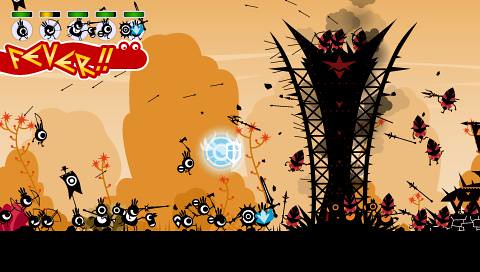
The gameplay in “Patapon 2” is simple. Each face button is a different drum and pressing them in specific orders to the beat will command your army to move, attack, defend and retreat. Later commands make the patapons charge their power or jump. Chaining four or five commands will cause the patapons to enter fever mode and raise their attack rate and critical damage dealt.

Up to four units, including the hero patapon, can enter battle. Missions range from gathering resources to destroying enemy camps and bosses, and customizing the patapons’ weapons and formation is important because of the game’s trial and error gameplay. Shield men in front of archers and spear men  is a good strategy.

“Patapon 2” allows you to revive patapons for free and does not penalize you for failing missions . This helps with the trial and error gameplay because sometimes the game does a bad job of hinting where to find necessary miracles to complete missions.  

Combat feels refreshed because of new units like robopons, mahopons, toripons and the hero patapon. Robopons wield gauntlets and hurl boulders, while mahopons are wizards and summon elemental damage. Toripons are the air unit and avoid most damage except from weather effects and archers. Old units from “Patapon” are also available.

The hero patapon is the most versatile unit because he can transform into any patapon unit available. Timing commands perfectly and entering fever mode will make the hero perform devastating attacks, and each attack is unique to the unit the hero is mimicking. 

If your Hero is a kibapon, he will constantly ram his spear into enemies for few seconds or more. If he is a dekapon, he will recklessly swing his mace around. These attacks helped me win numerous times by changing the flow of the battle.  

There are over 100 masks in the game and changing the hero’s mask will give him affects like higher resistance to fire or a higher attack rate, but you have to play the new multiplayer mode to unlock them.

You can play multiplayer with three friends over ad-hoc or with the computer and the purpose is to hatch eggs found in single player. The reward is either a heroes’ mask or a computer hero to use in multiplayer. Beating the boss that gave you the egg within a time limit and completing a rhythm mini-game hatches the egg, but most mask and computer heroes are not worth the repetitious experience.

The emphasis in “Patapon 2” is on evolving your patapons rather than what weapons they wield. This allows you to level up and specialize specific patapons to deal more critical damage, have a higher resistance to elemental damage and more. “Patapon 2” uses a spear grid system similar to the one from “Final Fantasy X,” but the difference is you have to unlock the same nodes for each individual unit and patapon. So you are repeating the same process 15 times or more if you choose to keep evolving your patapons. 

The manual does not explain evolution well and I unlocked toripons near the end of the game. It's not clear about finding some secret units on the grid as opposed to others.

Unlike in “Patapon,” the mini-games make gathering resources like hide, vegetables, minerals, fangs and money to unlock nodes and evolve patapons easier. “Patapon 2” also allows money and resources from “Patapon” to be transferred.

Levels are more diverse in “Patapon 2” and weather plays a larger role during battles. Constant freezing from blizzards or periodic stuns from lightening in thunderstorms are enough to give the enemy or yourself the advantage.  Luckily these effects can used or negated using miracles.

Miracles like the rain miracle negate fog and cool the desert sand, while the tailwind miracle changes the direction of the wind. Other new miracles include creating earthquakes, blizzards and thunderstorms.

The music is still entertaining will keep you playing with a smile. While the PSP's speakers work well, “Patapon 2” is meant to be played with headphones. 

A major fault carrying over from “Patapon” is not being able to pause. Missions range from 2 minutes to 15 minutes or more and the only way to “pause” is to put the PSP into sleep mode. 
“Patapon 2” is only offered as a downloadable title on the PlayStation Network and you will receive a redemption code if you buy the boxed copy. “Patapon 2” is 362 megabytes and saves to the Memory Stick Duo. The process was easy and took around 14 minutes to download on my wi-fi connection.  
“Patapon 2” is an improvement over “Patapon,” but the evolution grid and multiplayer feel like good ideas implemented wrong. The new units and enemies make combat more engaging. “Patapon 2” still manages to keep me smiling and chanting PATA PATA PATA PON. The charming characters, new units,  twice as long experience and lively music make “Patapon 2” a steal at $20.

Rating: B+
System: PSP>PlayStation Network
Price: $19.99
ESRB: E

Note: Images the PlayStation Blog